
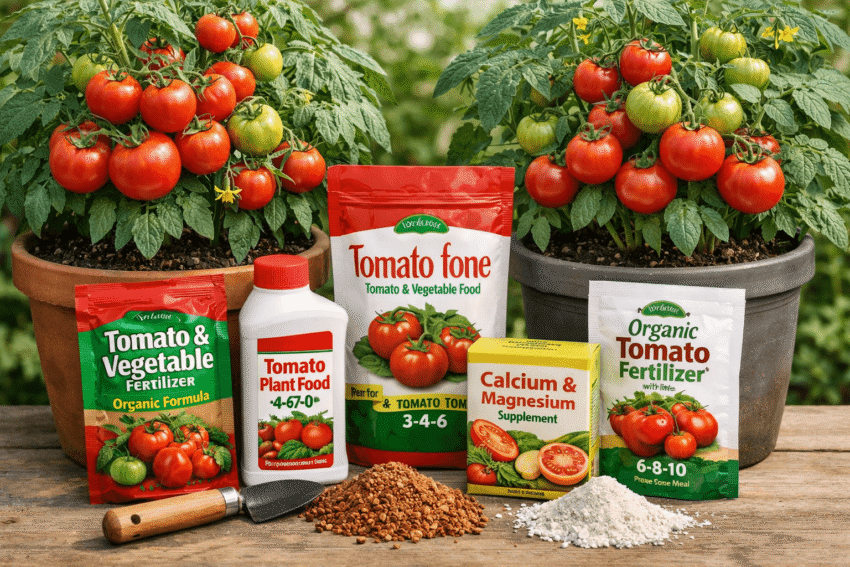
Best Fertilizer for Tomatoes in Containers
You should choose a fertilizer with a balanced N-P-K and slow-release nutrients, avoid overfertilizing that burns roots and reduces fruit, and feed consistently to produce bigger, sweeter tomatoes in containers.
Key Takeaways:
- Balanced slow-release granular fertilizer (example: 10-10-10) applied at planting provides steady baseline nutrients for container tomatoes.
- Use a bloom/fruit formula higher in phosphorus and potassium (example: 5-10-10 or 8-32-16) once flowering begins to support fruit set and development.
- Supplement with a dilute liquid feed (fish emulsion, seaweed, or water‑soluble tomato fertilizer) every 1-2 weeks during active growth at half the recommended strength.
- Supply calcium and micronutrients to prevent blossom end rot and deficiencies; options include calcium nitrate, crushed eggshells, or a complete micronutrient mix.
- Monitor for salt buildup and overfertilization: flush containers monthly, follow label rates, maintain potting mix pH around 6.0-6.8, and reduce nitrogen if foliage is excessive but fruiting is poor.
How-to Apply Fertilizer for Optimal Growth
Apply fertilizer sparingly to container tomatoes: feed at planting and then follow a steady schedule, using a balanced fertilizer and avoiding overfertilizing to prevent salt buildup. You should follow label rates and flush containers occasionally to maintain healthy roots and fruit.
Preparing the potting mix with starter nutrients
Mix a high-quality potting mix with a slow-release fertilizer or starter charge and a handful of compost. You must keep salts low; do not add raw manure. Aim for a light, well-draining mix so roots establish quickly and absorb nutrients efficiently.
Establishing a routine liquid feeding schedule
Feed container tomatoes with a balanced liquid fertilizer every 7-10 days, or dilute to half strength weekly during fruiting. You should watch leaves for burn and adjust frequency; consistent feeding supports steady yields.
Plan your liquid feeding around growth stages: apply higher nitrogen early for leaf development, then shift to higher phosphorus and potassium at flowering to encourage fruit set. You should measure EC or follow package dilution closely; overfertilizing causes root burn, blossom end rot, and salt buildup. Flush pots monthly and reduce concentration after heavy rain or heat to protect roots and fruit quality.
Essential Tips for Maintaining Soil Health
Keep your container mix loose, add compost and a slow-release fertilizer, and ensure drainage with perlite. Use the list below for quick checks. Monitor for overwatering and nutrient lockout to protect fruit set.
- Soil health: refresh with compost every season
- Watering: even, not soggy
- Fertilizer: balanced N-P-K, diluted for containers
Balancing hydration with nutrient uptake
Match watering to container size so you don’t cause nutrient lockout; allow light drying between waterings and feed with a dilute, regular fertilizer to keep uptake steady.
Monitoring pH levels in confined root systems
Test your container soil weekly for pH swings; aim for 6.0-6.8 and amend with lime or sulfur slowly to avoid shock, noting that imbalanced pH blocks nutrient uptake.
Adjust pH slowly in containers by testing with a reliable meter or probe weekly; small pots shift fast, so you should correct in small doses. Use dolomitic lime to raise pH and elemental sulfur or peat to lower it, mixing amendments into the potting mix. Rapid pH swings cause shock and nutrient lockout, so monitor and repeat cautiously.
Identifying Nutrient Requirements by Growth Stage
Plants change nutrient needs by stage, so you should boost nitrogen for foliage, then favor phosphorus and potassium for blooms; watch for deficiency signs like yellowing and avoid overfertilization that causes salt buildup.
Promoting leafy growth in the vegetative phase
You should use a fertilizer higher in nitrogen (for example, 10-4-4) during early growth, apply it at half strength weekly, and ensure adequate micronutrients while avoiding excess nitrogen that reduces later fruiting.
Boosting phosphorus and potassium during flowering
Flowering time calls for a bloom formula higher in phosphorus and potassium (for example, 5-15-10); you should reduce nitrogen to encourage fruit set and avoid overapplication that can burn roots.
Choose bloom fertilizers with N‑P‑K ratios skewed toward phosphorus and potassium (3-10-10 or 5-15-10), use water-soluble or liquid feeds every 7-14 days at half strength, monitor for salt buildup and flush containers periodically to prevent root burn, and check soil pH so phosphorus remains available.
Troubleshooting Common Fertilization Mistakes
Mistakes often show up as yellowing leaves, blossom end rot, or stunted growth; you can correct them by adjusting feed, water, and drainage. Check EC and pH regularly, and flush containers to remove salts. Avoid overfertilizing—excess salts and nitrogen can quickly damage roots and fruit quality.
Preventing nitrogen burn and salt buildup
Avoid giving concentrated high-nitrogen feeds; you should use balanced formulas and dilute to half-strength when seedlings are stressed. Leach pots every few months and use rainwater if your tap is hard, since salt buildup causes leaf scorch and root stress.
Remedying calcium deficiencies and blossom end rot
Treat early signs by applying foliar calcium sprays and switching to a low-salt, calcium-enriched fertilizer; you must keep soil moisture even and pH near neutral to prevent blossom end rot.
Monitor soil pH and moisture closely because calcium moves with water to fruit; inconsistent watering or high salt levels block uptake and leave you with rotten tomatoes. Use a weekly foliar calcium spray for quick relief and add granular calcium nitrate or gypsum to the potting mix for longer-term correction. Reduce ammonium-heavy fertilizers and flush containers to lower soluble salts; if damage is severe, remove affected fruit and focus on steady irrigation and balanced feeding.
Conclusion
You should pick a balanced, slow-release, or regular liquid fertilizer formulated for tomatoes, apply according to the label, and flush container soil periodically to prevent salt buildup and support steady fruiting and strong plant health.
FAQ
Q: Which type of fertilizer works best for tomatoes grown in containers?
A: Balanced, slow-release granular fertilizer mixed into the potting mix at planting combined with a water-soluble feed during the growing season gives the best results for container tomatoes. Use a balanced starter like 10-10-10 or 14-14-14 when transplanting, then switch to a bloom/fruit formula with higher phosphorus and potassium (example N-P-K ratios such as 5-10-10 or 3-4-6) once flowers appear. Controlled-release products (Osmocote and similar brands) provide steady nutrition for weeks to months, while liquid fertilizers (water-soluble tomato formulas and fish emulsion) supply quick, adjustable nutrients between slow-release doses. Organic options that perform well include compost or well-rotted manure in the mix, worm castings, fish emulsion for nitrogen, and kelp or rock phosphate for trace elements and P; choose a vegetable/tomato-specific formula when possible.
Q: How often should I fertilize container tomatoes, and at what strength?
A: Apply slow-release granules at planting according to the product label (most are rated for 3-6 months). Start water-soluble feeding once plants are established: every 7-14 days at half to full strength for synthetic feeds, or every 7-14 days at label strength for organic liquids like fish emulsion. Reduce frequency slightly during extreme heat or if growth slows. Flush containers with plain water if you see salt buildup on the soil surface, then resume feeding at reduced strength. Overfeeding causes leaf burn and poor fruit set, so lean toward slightly weaker, more frequent feeds rather than strong, infrequent doses.
Q: Should I use organic or synthetic fertilizer for container tomatoes?
A: Organic fertilizers release nutrients slowly as microbes break them down and improve potting mix biology and moisture retention; they work well as a base (compost, worm castings, rock phosphate) and are gentle on roots and pollinators. Synthetic fertilizers supply precise N-P-K ratios and fast correction of deficiencies, making them useful for targeted adjustments during flowering and fruiting. Many growers combine approaches: organic potting mix plus a controlled-release pellet at planting, then a water-soluble synthetic or organic liquid to correct needs during the season. Monitor plant response and soil salt levels to decide which approach suits your containers.
Q: How should I change fertilizer when tomatoes move from vegetative growth to flowering and fruiting?
A: Start with a fertilizer higher in nitrogen or balanced N-P-K while plants build foliage and root systems for the first 3-6 weeks after transplanting. Switch to a bloom/fruit formula when the first flowers set: choose a fertilizer lower in nitrogen and higher in phosphorus and potassium (for example, 5-10-10 or 3-4-6) to encourage fruit set and development. Continue regular feeding through fruiting, reducing nitrogen further if plants become overly leafy with poor fruiting. Maintain consistent watering and provide calcium if blossom end rot appears, since water stress or calcium shortage often limits fruit quality even when N-P-K is adequate.
Q: What are common nutrient deficiency signs in container tomatoes, and how do I correct them?
A: Nitrogen deficiency shows as uniform yellowing of older leaves and slow growth; correct with a high-nitrogen feed such as blood meal, ammonium nitrate, or fish emulsion per label directions. Phosphorus deficiency can cause stunted growth, poor flowering, and purpling of older leaves; correct with bone meal, rock phosphate, or a water-soluble fertilizer higher in P. Potassium deficiency appears as yellowing or browning at leaf margins and weak fruit; correct with potassium sulfate, kelp extracts, or a balanced fertilizer with higher K. Calcium deficiency produces blossom end rot on fruits and tip burn on leaves; correct by maintaining even soil moisture and applying calcium nitrate or gypsum and avoiding excess soluble salts. Magnesium deficiency causes interveinal chlorosis on older leaves and often responds to Epsom salts (magnesium sulfate) applied as a soil drench or foliar spray at recommended rates. Signs of overfertilization include brown leaf edges, salt crust on soil, and wilting despite moist soil; flush pots thoroughly and cut back feeding frequency and strength.